Completing Training Is Only the Beginning
You have completed the course and received the certificate. Perhaps you attended a practical skills programme, completed an internship, participated in a workshop, or learned a new skill online.
Now what?
For many people, this is where the difficult part begins. A certificate can show that you completed a programme, but it does not automatically create a job, client, business, internship, or other opportunity.
The next step is to turn what you have learned into something that other people can recognise and use. Whether you have learned digital marketing, graphic design, coding, catering, fashion, photography, agriculture, bookkeeping, welding, construction, business management, or another practical skill, the same principle applies:
Don’t just collect skills. Learn how to demonstrate, communicate, and apply them.
Here are practical ways to turn your training and skills into real career opportunities.
Identify What You Can Actually Do
Start by moving beyond the name of your course or training programme.
Instead of saying: “I completed a digital marketing course.” ask yourself: “What can I now do because I completed this training?”
For example, digital marketing training might help you develop skills in:
- Social media management
- Content creation
- Search engine optimisation
- Email marketing
- Digital advertising
- Analytics
- Content strategy
Similarly, someone who completed graphic design training may be able to:
- Design social media graphics
- Create brand identities
- Design marketing materials
- Prepare print-ready artwork
- Develop presentations
The important distinction is between having completed training and being able to perform a task.
Make a list of the practical things you can now do.
That list becomes the foundation for your career or business strategy.

Don’t Rely Only on Certificates
Certificates can be useful, particularly when an employer or programme specifically requires a qualification. However, a certificate alone may not tell someone how well you can apply a skill.
Consider two applicants.
Applicant A: Certificate in Graphic Design
Applicant B: Certificate in Graphic Design + portfolio containing branding projects, social media designs, posters, and other relevant work.
The second applicant has given the reviewer additional evidence of practical ability. Whenever possible, apply what you learned to real or realistic projects.
Create Projects That Demonstrate Your Skills
You don’t always have to wait for an employer to give you your first major opportunity. You can create projects yourself. For example: A person learning graphic design could redesign the branding of an imaginary business.
Someone learning web design could create a sample website for a fictional company. A digital marketing learner could develop a sample social media strategy. Someone studying data analysis could analyze a publicly available dataset and explain the findings. A photographer could develop a themed portfolio.
A video editor could create sample edits. A fashion student could document completed designs. A business learner could develop a simple business model around a genuine market problem. These projects provide evidence of application.
Make it clear that they are personal, academic, sample, or practice projects when appropriate. The purpose is to demonstrate your ability, not to present fictional work as client work.
Build a Portfolio
A portfolio is simply a collection of work that demonstrates what you can do. The format depends on your field.
It could be:
- A personal website
- LinkedIn projects
- A PDF portfolio
- A design portfolio platform
- A GitHub repository
- A photography gallery
- A video showreel
- A collection of writing samples
- A business case study
- A physical portfolio
Not every career requires a traditional portfolio. But if your work can be demonstrated visually, technically, or through completed projects, having evidence available can make it easier for others to understand your capabilities.
A simple project entry can include:
- Project Name
- Objective
- What you did
- Skills demonstrated
- Outcome: Explain the measurable result if it is a real project. For a practice project, describe what the project was designed to demonstrate instead.
This turns a collection of files into a meaningful portfolio.
Gain Experience Through Small Projects
You may encounter a frustrating requirement when looking for opportunities: “You need experience to get experience.”
There are ways to begin building relevant experience without waiting for the perfect full-time position.
Depending on your field, you could consider:
- Internships
- Apprenticeships
- Freelance projects
- Volunteer projects
- Community initiatives
- Student projects
- Personal projects
- Short-term contracts
- Competitions
- Collaborative projects
The key is to choose activities that help you build relevant evidence.
If you want to work in social media, for example, managing a real organisation’s social media project can provide more useful evidence than simply completing another introductory course.
If you want to work in web design, building several practice websites can help you demonstrate your capabilities.

Turn Your Skills Into a Clear Professional Profile
People need to understand what you do. Avoid describing yourself only with broad statements such as: “I am a hardworking young person with many skills.” Instead, be specific.
For example: “I create social media content and manage digital platforms for small businesses.”
or: “I design responsive websites for small businesses and professionals.”
or: “I provide bookkeeping and basic financial record-keeping services for small businesses.”
A clear professional description helps employers, clients, programme organisers, and potential collaborators understand where your skills fit.
Match Your Skills to Real Problems
A skill becomes more valuable when you can connect it to a problem someone needs solved.
For example:
Skill: Graphic design
Problem: A small business needs professional promotional materials.
Skill: Web design
Problem: A business needs a website to present its services online.
Skill: Video editing
Problem: A content creator needs videos prepared for social media.
Skill: Data analysis
Problem: An organisation needs help understanding its data.
Skill: Catering
Problem: Individuals or organisations need food prepared for events.
This way of thinking can help you identify employment, freelance, business, and project opportunities.
Instead of asking only: “Who is hiring someone with my skill?”
also ask: “Who has a problem that my skill can help solve?”
Use Your Training to Strengthen Your CV
Your CV should show more than a list of courses. Where appropriate, connect your training to practical skills and experience.
For example:
Training: Digital Marketing Certificate
Skills developed: SEO, content planning, social media analytics, email marketing
Application: Developed a sample digital marketing campaign and analysed its performance.
This gives a potential employer more context. If you have completed several short courses, don’t assume that listing all of them will automatically make your CV stronger. Prioritize training that is relevant to the opportunity you are pursuing.
Make Your Work Easy to Find
Having useful skills is one thing. Making it easy for the right people to discover those skills is another.
Depending on your career, this might involve maintaining a professional presence on:
- A personal website
- A portfolio platform
- Industry-specific platforms
- Professional networks
- Relevant social media channels
Your profile should clearly communicate:
- Who you are
- What you do
- What skills you have
- What evidence you can show
- What opportunities you are looking for.
Keep your information accurate and professional. You do not need to be active on every platform. Focus on the places where people in your field actually look for talent, services, or professional connections.
Start Networking Before You Need a Job
Networking is not simply asking people: “Do you have a job for me?” It is about building genuine professional relationships.
You can:
- Attend relevant events
- Join professional communities
- Participate in workshops
- Connect with people working in your field
- Engage thoughtfully with professional content
- Ask informed questions
- Share useful work
- Stay in contact with people you meet
Over time, these relationships can expose you to information about opportunities that may not be widely advertised. The goal should be to build relationships, not collect contacts.
Don’t Stop Learning, but Don’t Hide in Training Either
Continuous learning is valuable. There is always another course, another certificate, another workshop, and another training programme available. But there comes a point where you need to apply what you already know.
If you spend months collecting certificates without creating anything, gaining experience, or applying for opportunities, your training may not be translating into career progress.
Try to maintain a balance: Learn → Practice → Apply → Get feedback → Improve → Learn again.
Training should support action, not replace it.
Look Beyond Traditional Employment
Your skills do not necessarily have to lead only to a conventional full-time job. Depending on your abilities and circumstances, you might explore:
- Employment
- Internships
- Freelancing
- Consulting
- Contract work
- Entrepreneurship
- Apprenticeships
- Partnerships
- Project-based work
- Further education
- Fellowships
- Professional programmes
For some people, the first opportunity may be a small project rather than a permanent position. That experience can then help create evidence for larger opportunities.
Use Opportunities to Build More Evidence
When you find a relevant job, internship, training programme, fellowship, grant, or competition, don’t think only about what you will receive. Consider what you could build or demonstrate through participation.
For example, an opportunity might help you gain:
- Industry experience
- A completed project
- A professional reference
- A portfolio item
- New technical skills
- Business experience
- Teamwork experience
- Leadership experience
- Professional connections
This creates a cycle where each relevant opportunity can potentially strengthen your profile for the next one.
Apply Your Skills Locally While Looking for Bigger Opportunities
You do not necessarily need to wait for an international organisation or major company to recognise your skills. Look around you.
Small businesses, community organisations, schools, entrepreneurs, professionals, and local businesses may have problems that require practical skills.
For example:
- A business may need a website.
- A restaurant may need better promotional content.
- A small organisation may need help managing its social media.
- A business owner may need basic bookkeeping.
- A community group may need design support.
- A local entrepreneur may need help documenting products or services.
Approach these opportunities professionally and be clear about what you can offer. Even small projects can help you develop experience, relationships, and evidence of your abilities.
Keep Applying for Relevant Opportunities
Building skills and experience does not replace applying. It strengthens your applications. Once you have developed your skills, created evidence, and improved your professional profile, continue looking for relevant:
- Jobs
- Internships
- Scholarships
- Fellowships
- Training programmes
- Grants
- Entrepreneurship programmes
- Freelance projects
- Competitions
Our previous articles on finding opportunities and successfully applying for opportunities can help you with those stages. And after submitting an application, remember to stay organized, follow up appropriately, and prepare for possible interviews or assessments.

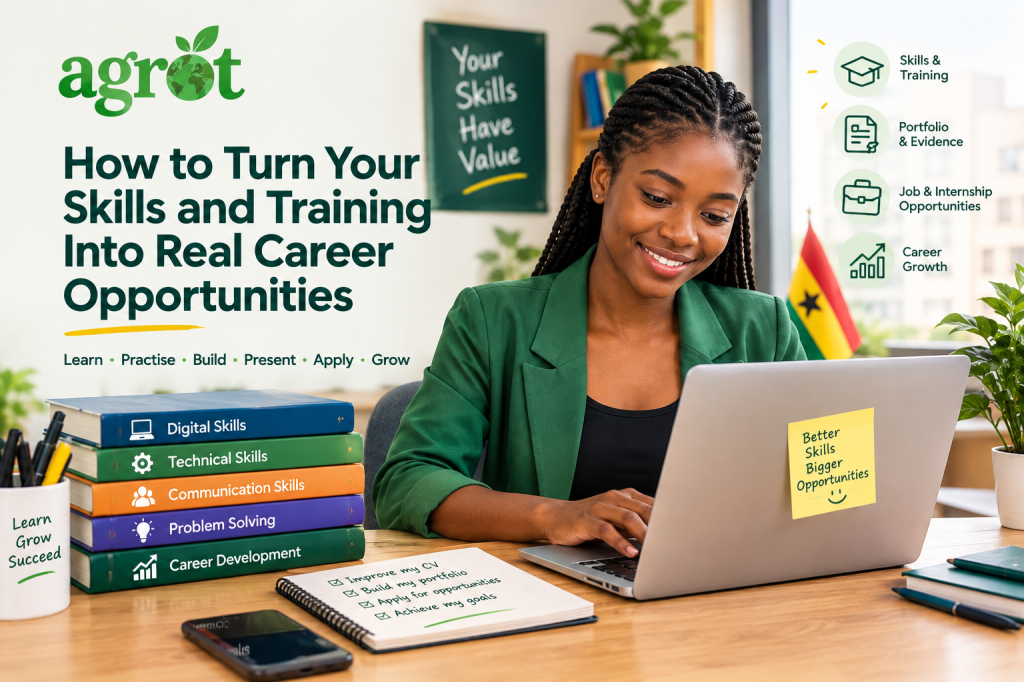
A Simple Skills-to-Opportunity Framework
You can think of the process as six steps:
1. Learn: Develop a relevant skill through education, training, practice, or experience.
2. Practise: Use the skill repeatedly rather than relying only on classroom knowledge.
3. Build: Create projects, work samples, or other evidence of what you can do.
4. Present: Communicate your skills clearly through your CV, portfolio, professional profile, or applications.
5. Apply: Look for opportunities where your skills match genuine needs.
6. Improve: Use feedback and experience to strengthen your skills and approach.
Then repeat the process.
Learn → Practice → Build → Present → Apply → Improve.
What If You Don’t Have Enough Experience Yet?
- Don’t let the lack of formal employment experience stop you from building evidence.
- Start with what is available to you.
- A personal project can demonstrate initiative.
- A school or university project can demonstrate technical ability.
- An internship can provide workplace exposure.
- A volunteer project can demonstrate teamwork.
- A freelance assignment can demonstrate client experience.
- A portfolio can demonstrate practical ability.
The important thing is to be honest about what the experience was and what role you played. Over time, small pieces of evidence can develop into a stronger professional profile.
Your Skills Need a Path to Opportunity
Learning a skill is an important first step, but it is not the destination. The real value of training begins to emerge when you can apply what you learned, demonstrate your ability, solve problems, and communicate your value to the people who need those skills.
You do not need to have everything figured out before you begin.
- Start with one skill.
- Practise it.
- Build something.
- Document what you do.
- Share your work appropriately.
- Look for relevant opportunities.
- Learn from the results.
- Then keep improving.
Whether your goal is employment, entrepreneurship, freelancing, further training, or another career path, the transition from learning to doing is what can turn a skill into an opportunity.
Final Takeaway
- A certificate can show that you completed training.
- Your work can show what you can do.
- Your experience can show that you can apply it.
- Your professional profile can help people understand your value.
- And the opportunities you pursue can help you continue developing.
- So don’t stop at “I have the skill.”
- Ask: “What can I do with this skill, what evidence can I show, and who needs what I can do?”
That is where skills begin to become career opportunities.
Explore More Resources from AgroT Hub
If you are currently developing your skills or looking for opportunities, explore AgroT Hub’s related resources:
- Skills Young People Need to Build Sustainable Livelihoods in 2026
- How Young People Can Turn Skills into Income in Today’s Economy
- Why Practical Skills Training Matters More Than Ever for Young People
- Opportunities for Youth, Women, and Persons with Disabilities in Ghana
- How to Successfully Apply for Grants, Training Programmes, and Business Opportunities in Ghana
- What to Do After Applying: How to Follow Up, Prepare for Interviews, and Track Opportunities
The goal is not simply to acquire more skills. It is to make those skills useful, visible, and connected to real opportunities.