Plants Are Talking, What If We Listened?
On many African farms, especially smallholder plots, farmers are attuned to their crops, watching for leaf color, listening to birds, sensing when something’s off. But what if we told you plants are communicating more than we thought, beneath the soil, through the air, and even in sound?
Science is revealing a hidden world where plants share warnings, exchange nutrients, and respond to threats in remarkably smart ways. For us at AgroT Hub, these findings aren’t just fascinating, they’re a wake-up call. Tapping into plant communication could help us build more resilient, sustainable agricultural systems right here in Africa.
Let’s explore how…
Plants Warn Each Other Using Chemicals
Nature’s Early-Warning System
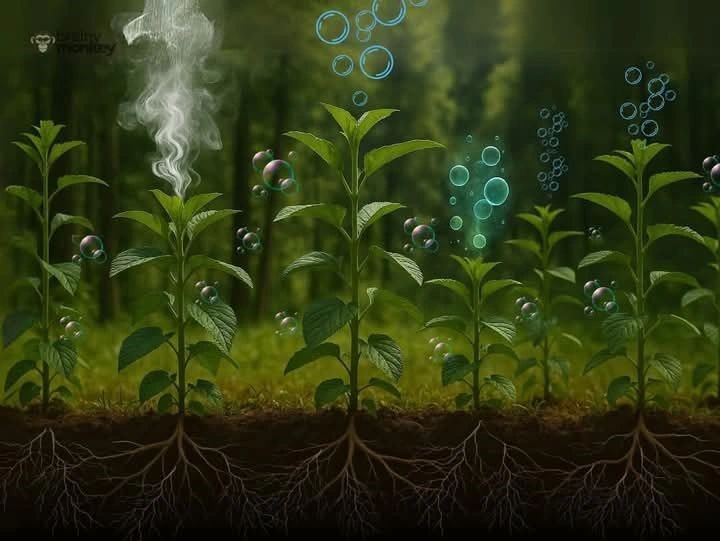
When pests attack a cassava or maize plant, it doesn’t keep quiet. It emits volatile organic compounds (VOCs), chemical signals released into the air. Nearby plants “smell” the danger and boost their own defenses, even before the pests arrive.
This isn’t theory. It’s happening right now in your fields.
Real-Life Relevance
In one study, maize plants released VOCs when under attack by stem borers. Neighboring plants picked up the signal and began producing more protective compounds, naturally reducing pest spread without any pesticides.
For African farmers, understanding these natural defense systems could lead to low-cost, eco-friendly pest control, especially in areas where access to agrochemicals is limited or risky.
The “Wood Wide Web” Beneath Our Feet
What Is It?
Underground, plant roots are connected by mycorrhizal fungi, forming a complex network scientists call the “wood wide web.” Through it, plants exchange:
- Nutrients (like phosphorus and nitrogen)
- Water
- Stress signals
- Even carbon
This network is essential for soil health, forest restoration, and regenerative farming, principles AgroT Hub actively promotes.
Indigenous Wisdom & Modern Science
Interestingly, this isn’t new to African agriculture. For generations, agroforestry practices in regions like Ghana, Kenya, and Nigeria have intercropped trees and crops to improve soil fertility. What science is now validating is what many African farmers already knew intuitively: plants support each other when given the chance.
Explore Suzanne Simard’s TED Talk: How Trees Talk to Each Other
Plants Make Sounds, And They Might Be Heard
Ultrasonic Plant Clicks
Researchers recently discovered that stressed tomato and tobacco plants emit ultrasonic clicks, tiny popping noises humans can’t hear, but insects, animals, and maybe even other plants can.
Imagine a thirsty tomato “clicking” to signal drought stress. Or a damaged cassava warning its neighbors. While this area of research is still emerging, it opens powerful possibilities for acoustic monitoring in smart farming.
Future of Sound Farming?
Devices might soon be able to “listen” to crops and alert farmers when a plant is stressed before any visual sign appears. For AgroT Hub, this is the future: tech and nature working together!

Plants Use Electrical Signals Too
When a plant is wounded, say, a cowpea’s stem is cut, it sends electrical signals from the site of injury to other parts of the plant. These signals trigger protective responses like closing stomata (to reduce water loss) or producing bitter compounds (to deter herbivores).
This is not just a reaction; it is survival intelligence.
The Secret Ways Plants Communicate
| Method | Medium | What It Does |
|---|---|---|
| VOCs | Air | Warn neighbors of pests or stress |
| Mycorrhizal Fungi | Soil network | Share nutrients and messages across plant roots |
| Ultrasonic Clicks | Sound | Express stress, drought, or damage |
| Electrical Signals | Internal | Trigger rapid defense and survival responses |
What This Means for African Agriculture
- Smarter Pest Control: By planting companion crops that boost VOC signals, we could naturally repel pests.
- Regenerative Soil Management: Fostering healthy fungal networks improves yield without synthetic fertilizers.
- Precision Farming Tools: Listening to plants through bioacoustic tech could be the next step in climate-smart agriculture.
At AgroT Hub, we believe innovation must be rooted in both science and nature, and this is the perfect example.
FAQS
Can African farmers use plant communication in the field?
Yes! Practices like intercropping, mulching, and maintaining fungal-rich soil naturally support communication networks and plant resilience.
Are plants really intelligent?
While they don’t “think” like humans, plants can sense, respond, and adapt to their environment, intelligently defending themselves and supporting others.
How does understanding plant communication help food security?
Understanding how plants communicate helps us grow food more efficiently, sustainably, and with fewer inputs, crucial in the face of climate change and soil degradation.
Your Farm Might Be Talking, Are You Listening?
At AgroT Hub, we’re helping farmers, researchers, and innovators across Africa harness natural intelligence for a smarter agricultural future. Ready to join the conversation?
Get in touch with us for fresh insights from the field.